For years, enterprises have relied on commercial insurance to protect themselves against operational failures, workplace injuries, property damage, and professional negligence. As generative AI moves into business operations, some of that protection may no longer be guaranteed.
The US insurance market is beginning to make this explicit.
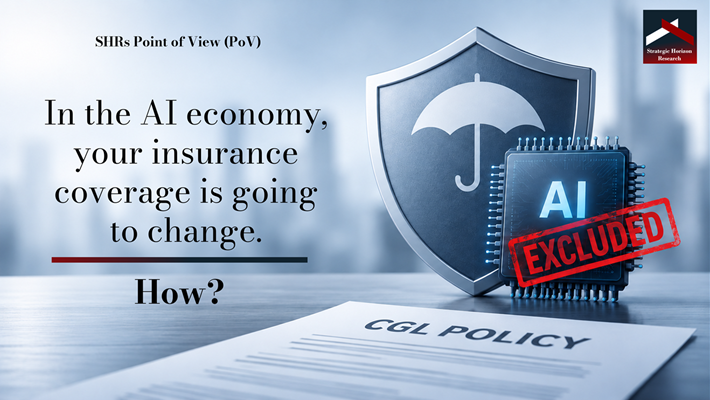
In January 2026, the Insurance Services Office (ISO), which develops standardized insurance policy forms used by US insurers, introduced new endorsements that specifically exclude certain Gen AI-related claims from commercial general liability (CGL) coverage.
Why is it significant? Because it is leading to a trend in which insurance companies may be moving from treating AI as an emerging risk within existing policies to explicitly writing it out of certain coverage. It is not happening yet right now, but at the speed AI is posing unforeseen risks, underwriters will have to treat them differently.
And, the implications extend well beyond the insurance industry. Let’s evaluate this in steps with examples:
When does AI become part of the liability chain?
Consider a manufacturing company using AI to investigate workplace incidents. The system reviews accident reports, identifies potential causes, and recommends corrective actions.
Management accepts its recommendations. A safety issue goes undetected, and another employee gets injured.
The company could now face a liability claim.
Traditionally, its CGL policy might have protected against claims involving bodily injury. However, if the insurer has attached ISO’s new generative AI exclusion, coverage could be disputed or denied, because earlier recommendations, that were AI-generated and not adequately verified by a human.
The important distinction is that the AI system does not need to have physically caused the injury. Its contribution to the decision-making process could become relevant to determining whether the exclusion applies. This is where things get complicated. AI is rarely the sole cause of an operational failure. It may have generated a recommendation, influenced a human decision, or contributed to a process that ultimately resulted in harm. Determining where liability sits is difficult enough. Determining whether insurance covers it adds another layer of uncertainty.
Now, of course, the exact outcome will depend on the policy wording, the circumstances of the incident, and applicable law.
The exclusions are spreading beyond general liability
CGL is only part of the picture. Other coverage areas like professional liability policies, including Errors & Omissions (E&O), are also seeing AI-specific exclusions. These policies typically protect businesses against claims arising from errors in the professional services they provide.
Directors and Officers (D&O) coverage is another area of concern.
W.R. Berkley introduced an AI Exclusion (Absolute) endorsement (PC 51380, June 2024), which excludes claims arising from the use, deployment, or development of AI. The exclusion extends to D&O, employment practices and fiduciary liability coverage parts.1 Insurance Journal subsequently reported its application across Berkley’s D&O, E&O and fiduciary products.2,3
Meanwhile, insurers are paying closer attention to how businesses develop, deploy and govern AI. Documented human oversight, approval protocols and accountability structures are becoming relevant to underwriting decisions. Your Human and AI Operating model and AI Governance become the key in the assessment.
In fact, AI governance could influence not just an enterprise’s ability to deploy AI, but also the terms on which it can obtain insurance.
An emerging gap in enterprise risk management
Now, there are three developments worth watching.
First, AI usage is becoming an underwriting consideration: Insurers may want to know where AI is being used, what decisions it influences, and what controls are in place. A generic statement that the organization has an AI policy will probably be insufficient for higher-risk deployments.
Second, traditional insurance assumptions are being challenged: Enterprises have historically purchased coverage around business activities, operational risks, and professional responsibilities. AI introduces a new dimension: the technology usage itself may become a basis for excluding certain claims.
Third, replacement coverage remains uncertain. When standard CGL policies exclude AI-related losses, where does an enterprise obtain equivalent protection? Specialized AI insurance products exist, but whether they cover the same exposures is a separate question.
So, what should CIOs and enterprise risk leaders do?
It’s a no-brainer to say that the CIO, Chief Risk Officer, Legal, Procurement, and the insurance broker need to collaborate. But how?
Start by mapping AI usage against existing insurance coverage. It will involve identifying applications that influence workplace safety, product design, operational decisions, customer interactions, and professional services.
Then review the actual policy endorsements. We can’t assume that an existing CGL or E&O policy automatically covers an incident simply because the business activity itself was previously insured.
Finally, establish clear accountability for consequential AI outputs; here, both the Human+AI Operating Model and AI Governance become the foundation of enterprise AI usage. These two frameworks will help you document where human validation is required, who approves decisions, and how exceptions are handled. These controls matter operationally, as well as influence how insurers assess the business.
We must understand the bigger picture, even if our current insurance provider hasn’t changed its exclusions.
And the bigger picture is that there is a broader shift taking place in enterprise AI risk management as AI is becoming the biggest risk most organizations are facing today.
Until now, much of the discussion has focused on responsible AI, regulatory compliance, cybersecurity, and model governance. Insurance introduces a different question: If an AI-related incident causes financial or physical harm, who pays for it?
That question deserves a place in enterprise AI strategy.
An organization may have the right to deploy an AI system, the technical capability to operate it, and the governance framework to manage it. Yet, if its insurance excludes the resulting liability, it may still be carrying an unacceptable financial exposure.
AI governance and the Human+AI operating model determine how responsibly an enterprise uses AI. Insurance determines how much of the resulting risk it can transfer. Neither can substitute for the other.
For CIOs and CROs, the next step in AI maturity may be to connect technology governance with enterprise risk financing. Going forward, the cost of getting that relationship wrong could be considerably higher than the cost of the AI itself.
References
- W. R. Berkley Corporation, “Artificial Intelligence Exclusion (Absolute),” Endorsement PC 51380 00 06 24, Jun. 2024. Source
- Insurance Journal, “Insurer interest in AI coverage exclusions growing as risk becomes omnipresent,” Aug. 17, 2026. insurancejournal.com
- Jones Day, “‘A-Eye’ on coverage: Maximizing insurance for AI risks amid emerging exclusions,” Apr. 2026. jdsupra.com
- Mark Rosanes, “ISO’s generative AI exclusion is already on thousands of CGL policies,” Sep. 16, 2026. insurancebusinessmag.com