AI costs keep surprising everyone. But why?
Ask any CIO about AI budgets this year, and you will likely hear a story about an overrun. In October, Accenture capped centrally funded Claude use at $29 per employee per month after some of its people spent up to $1,000. McKinsey reports that AI spend rises nearly fourfold when an organization moves from isolated use cases to enterprise-wide adoption, and 93% of the leaders it surveyed have already exceeded their AI budgets.
So what is going wrong? Most organizations blame excess spending, poor visibility, or weak attribution. I see those as symptoms. The deeper problem lies in how we understand the economics of AI. IT cost management grew up on predictable units such as users, transactions, and uptime. AI behaves differently. The same task can cost very different amounts depending on the model you pick, the context you send, how deeply the model reasons, and how the work runs.
Four shifts every CIO should know
- In classic IT, learning gains cut resource use. With AI, cheaper and smarter models invite more use, so your bill climbs as your capability grows.
- A saving in inference can add cost to orchestration, infrastructure, or human review. Press one side of the balloon, and the other side grows.
- One user request can trigger dozens of model calls, tool calls, and retries. When agents run work on their own, last year’s usage tells you little about next year’s.
- A reviewer who earns $60 an hour and spends two minutes on each output adds $2 per item, while the model call behind it costs a few cents. If 30% of outputs need rework, a cheaper model hardly matters.
Where the usual advice stops short?
Most guidance tells you to tag your cloud spend, negotiate better token prices and route work to cheaper models. You should do all three. These steps only manage what AI consumes, though. They leave out the reviewer, the retry, the rework and the AI premium that SaaS vendors now build into their renewals. A token dashboard will never show you that your cheaper model just doubled your review costs.
How do we rethink the whole approach?
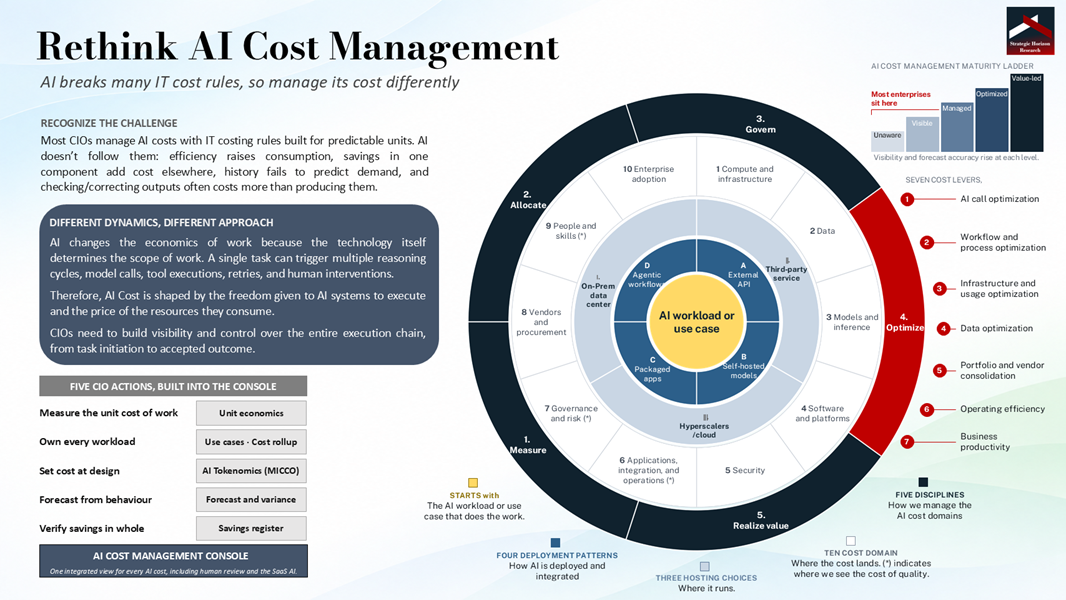
We need to measure the cost of getting the work done, from start to end, input to Outcome (not output). This framework tracks cost per successful outcome across the whole workload, from the moment a task enters the system to the point where someone acts on its output. It helps you build complete traceability for an AI initiative.
- Ten cost domains, as identified in this framework, capture every AI dollar, from compute, data and models to people, security, governance and enterprise adoption.
- Five disciplines, Measure, Allocate, Govern, Optimize, and Realize value, turn that spend into evidence a CFO can trust.
- Seven optimization levers cut cost, led by MICCO, which makes every AI call cheaper.
- A five-level maturity model shows where you stand today, and most enterprises we see sit at level 1 or 2.
The framework also changes when you manage cost. It moves cost decisions into architecture review, before production locks in the economics. It gives every AI assistant, AI workflow, and AI agent a named cost owner. It helps you base the forecasts on workload behavior, and counts a saving only when cost per outcome falls, and quality holds.
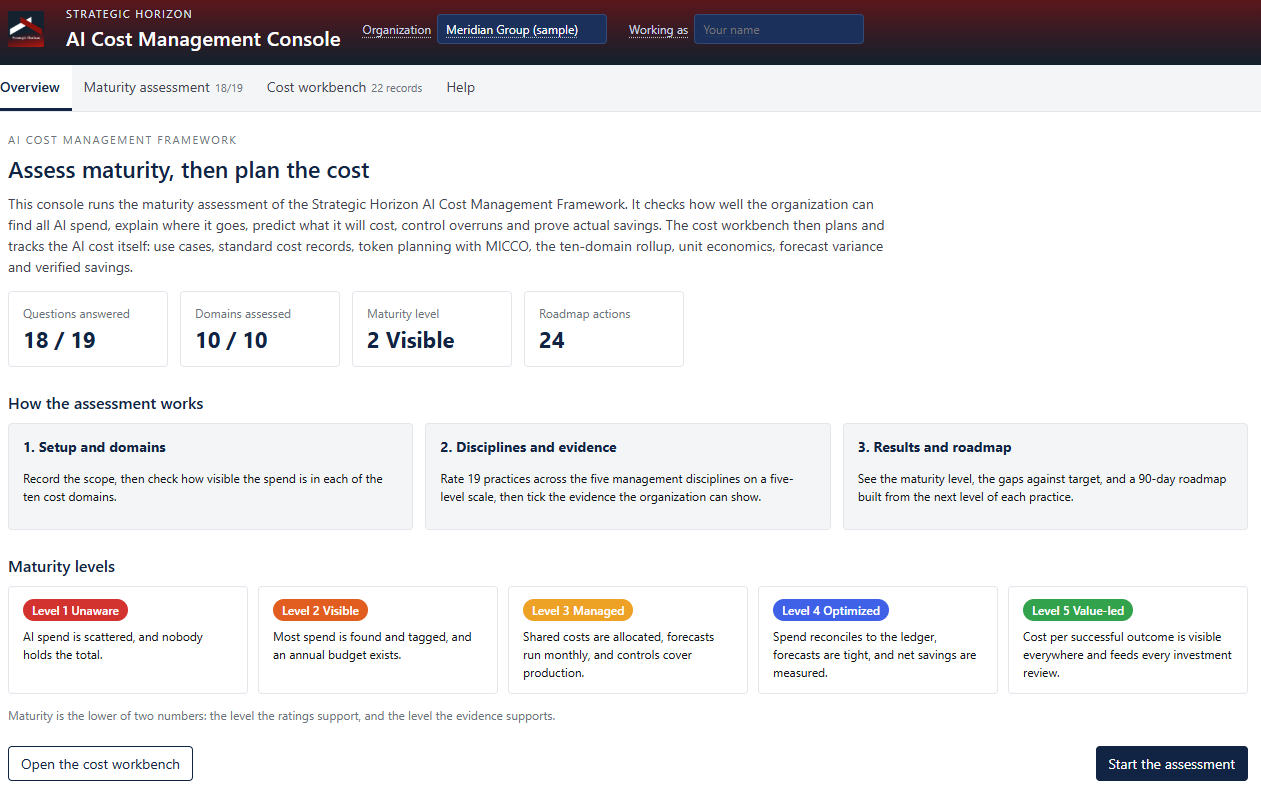
By following the framework and implementation plan, you will essentially build an AI Cost Management Console – an integrated system that runs all of this. It keeps every AI cost in one ledger, including human review, and it splits every variance into volume, efficiency, mix, and price.
Keeping cost ownership from drifting
The console above is something we build with you, most often in an advisory engagement. The part leaders return to is the maturity assessment. It scores each of the five disciplines against a target level and turns the gap into a roadmap. Re-run it every quarter and you will see whether cost ownership is improving or sliding back to nobody.
Nobody should be surprised to hear that the CIOs who learn the new economics of AI will control its costs. Everyone else? will keep explaining the overruns.