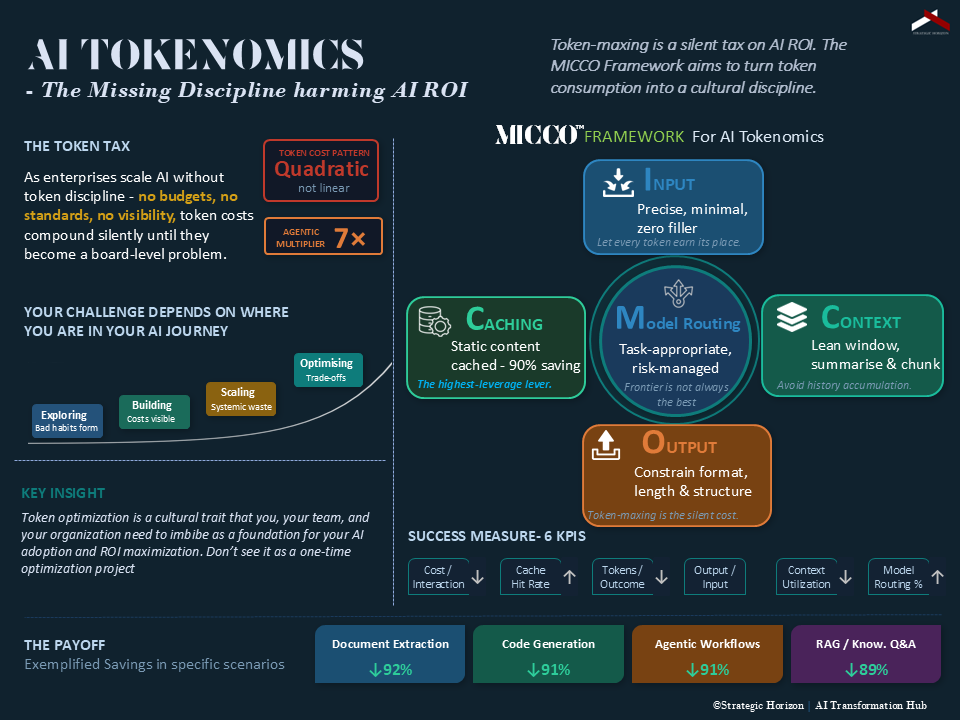
AI Tokenomics
Bridge the missing link harming AI ROI
Microsoft canceled internal Claude Code licenses for its employees due to skyrocketing token consumption costs (source: Fortune.com)
OpenAI CEO Sam Altman reveals AI token costs are a huge issue in 2026 (Source: Yahoo Finance)
Legal AI has a growing token price problem (Source: Artificial Lawyer)
These are just a few recent news stories making the headlines in the AI world. And I get the feeling of déjà vu.
Until AI became the poster child of global technology, cloud adoption was also facing a similar challenge: uncontrolled, ungoverned cost. The Lift & Shift approach, without understanding unit economics, of cloud migration was the culprit.
At roughly $200 of token usage per employee per week, that's about $10,000 a year per person. With 90,000 employees, the company is looking at $900 million annually. Tokens are blocks of data that models use to generate information. Usage is billed by the number of tokens processed.
— Jeetu Patel, Chief Product Officer, Cisco (Source: CNBC)
Enterprises are making the same mistake with AI adoption. Scaling AI without a unit economics discipline which means no token budget, no optimization measures, and no visibility into what is being consumed or why. The result is that AI costs grow faster than AI value, and in turn, threaten the business case for enterprise AI before it has a chance to prove itself.
Why Tokenomics Matters Now
Tokenomics needs to be taught and thought from the start because it is a governance obligation for sustainable AI adoption. Without it, AI becomes a cost centre that leadership will not be able to explain, control, or justify.
What This Blueprint Includes
This blueprint gives AI leaders the vocabulary, the framework, and the use cases to change that:
- Section 1 sets out the scale of the problem
- Section 2 builds the vocabulary every AI leader needs
- Section 3 maps the challenges to where your organisation sits today
- Section 4 introduces the MICCO Framework: an integrated discipline that addresses all of it
- Section 5 shows it working in practice across four enterprise use cases
The organisations that build token economics into their AI programmes from the start will have a structural cost advantage over those that treat it as a cleanup task. Start where you are. The cost of waiting compounds just like tokens do.