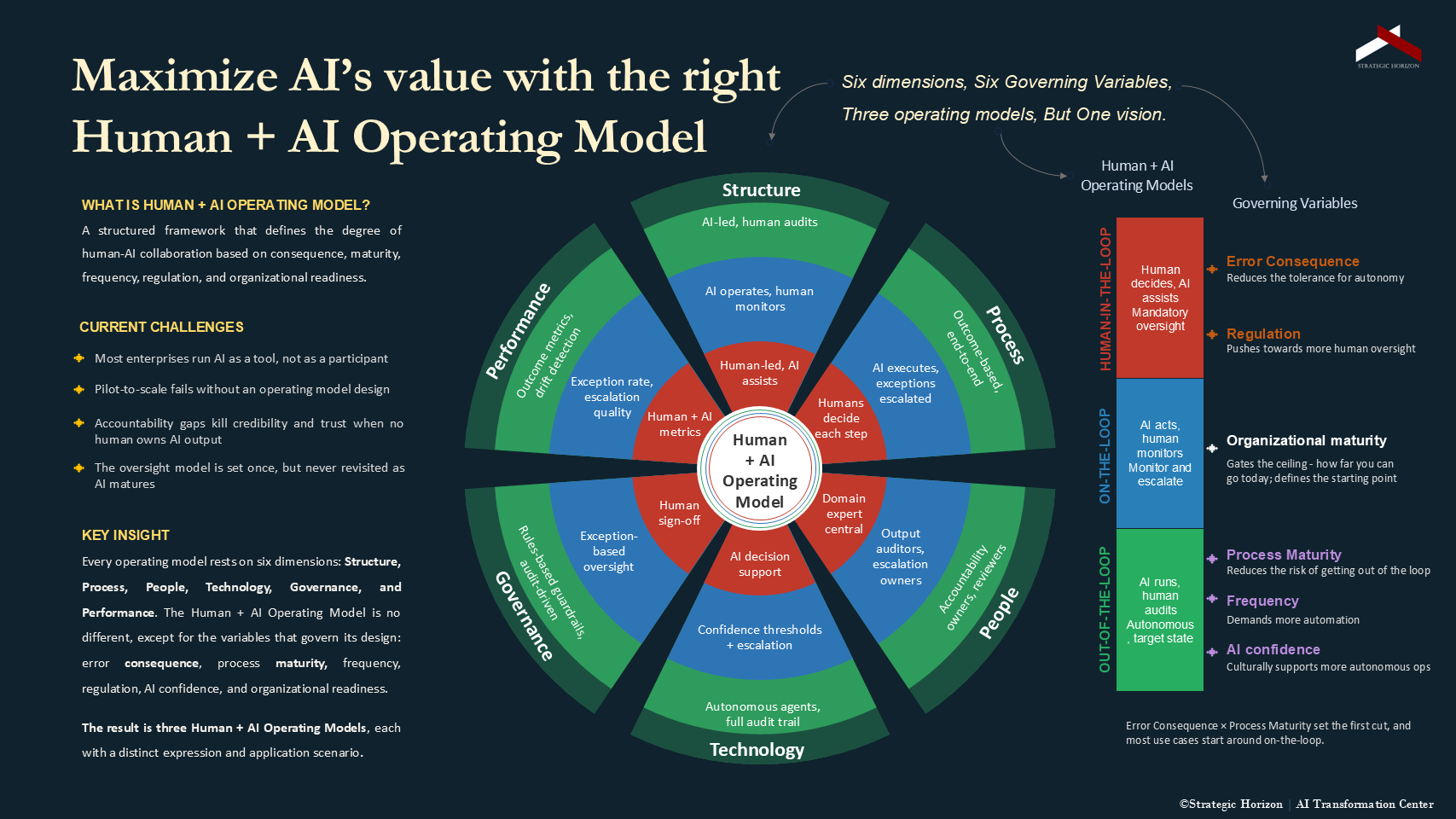
Maximize AI's value with the right Human+AI Operating Model
Six dimensions, Six Governing Variables, Three operating models, But One vision
A few weeks ago in a local conference, a COO told me, with genuine pride, that her team reviewed every output of their new underwriting AI Agent. Every single one. Three analysts, full-time. When I asked what percentage of the AI's recommendations they actually overturned, she checked. The answer was under 2%. Her company was paying three professionals to agree with AI.
Now, take a case of Air Canada's chatbot, which invented a bereavement-refund policy that didn't exist. So, when it made it to the court, the tribunal ordered the airline to pay up. It rejected Air Canada's argument that the bot was "a separate legal entity responsible for its own actions." So essentially, while the bot (mis)spoke, the airline still paid. (Source: CBC News, Feb 2024: cbc.ca/news/canada/british-columbia/air-canada-chatbot-lawsuit-1.7116416)
Did you notice something? Well, both organizations had an AI operating model. However, neither designed it, and most probably never even looked at it in this manner. These models emerged over deployments, shortcuts, and unexamined defaults, one at a time. So, if you ask an executive team how they decide how much autonomy their AI agents should hold, most likely you will get the corporate equivalent of a shrug.
The Human+AI Operating Model is our answer to that shrug.
Our point of view is that AI models are commoditizing fast. And, in this emerging scenario, the question that actually matters is how much authority you grant an agent, and who answers for what it decides. Finding that right balance is the key to realizing the full potential of what AI can offer.
Three Postures, Six Dimensions
The Human+AI Operating Model framework defines three postures: Human-in-the-Loop, where the human decides, and the AI assists; Human-on-the-loop, where the AI acts, and humans handle the exceptions; and Human-out-of-the-loop, where the AI runs, and humans audit. The six dimensions (Structure, Processes, People, Technology, Governance, and Performance) underneath are where the three postures actually part ways.
The Two Variables That Matter Most
Also, finding the right posture shouldn't be a judgment question, either. Of the six variables (Error Consequence, Regulation, Organizational maturity, Process Maturity, Frequency, AI confidence) we score, two do most of the work:
- Error Consequence (how badly an error can hurt you), and
- Process Maturity (how well you actually understand the process).
When we tested different process scenarios against our scoring rubric, we uncovered that most work lands closer to autonomy than our instincts may suggest.
In fact, while researching this piece, I asked a few AI leaders how they supervise their agents, and we saw a pattern emerge: in well-tested areas, most hover like new parents over a babysitter, while in the corners that nobody mapped, the agents run unsupervised. Neither is a decision; both are habits.
Keep Moving Up the Curve
Finally, your selection of a Human+AI operating model shouldn't remain static. It shall move as your organization, its capabilities, and its processes move up the six variables. To win in the AI economy, organizations will have to keep re-placing themselves and adopting the next posture as they move up the AI adoption journey.
The winners of the AI era won't be the companies with the best models. They'll be the ones who know when to let go. That's a decision worth making on purpose.