AI is increasingly shaping decisions about growth, operating models, customer experience, capital allocation, talent, and risk. Yet many boards are still approaching AI primarily as a technology or risk topic. That creates a governance problem.
When directors lack enough AI literacy to challenge management’s assumptions, it becomes harder to distinguish a credible opportunity from an impressive demonstration, strategic investment from experimentation, and evidence-backed conviction from executive enthusiasm.
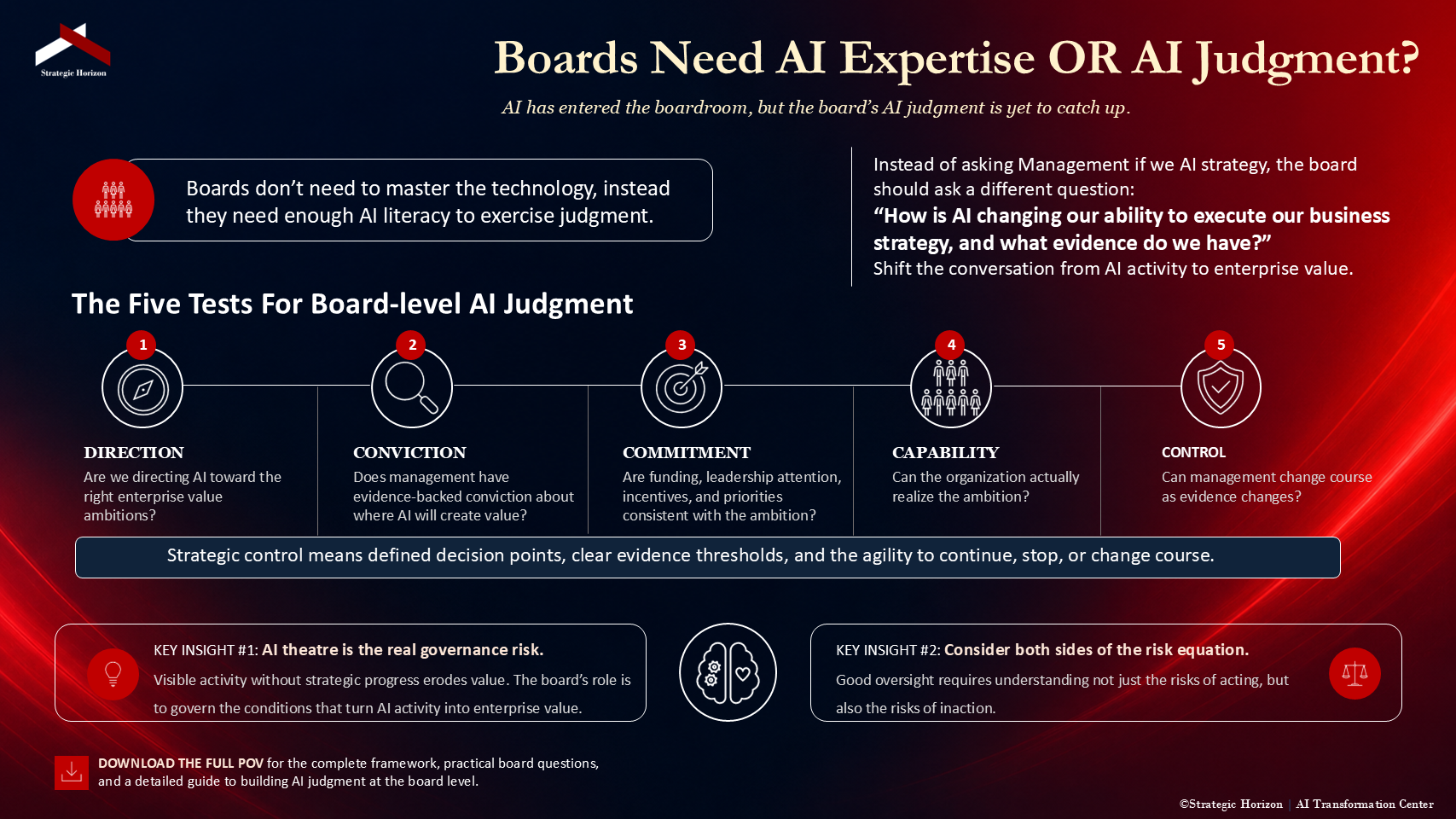
The answer is not to turn every director into an AI expert. Boards need enough AI literacy to exercise judgment.
That means being able to ask whether an AI proposal is strategically relevant, whether the evidence supports the investment, what capabilities are required to realize the value, and what would cause management to change course.
It also means looking at both sides of the equation. What could happen if the company pursues an AI opportunity? What could happen if it does not?
The board should ask a different question
“Do we have an AI strategy?” is increasingly difficult to answer meaningfully. An organization may have pilots, tools, use cases, an AI vision, and considerable activity without having a strategy that changes how the enterprise executes its business strategy. A more useful board question is:
How is AI changing our ability to execute our business strategy, and what evidence do we have?
That question shifts the conversation from AI activity to enterprise value. Our PoV proposes five tests for board-level AI judgment:
| Test | The board should examine |
|---|---|
| Direction | Where is AI expected to change the enterprise? |
| Conviction | What evidence supports management’s choices? |
| Commitment | Are capital, leadership attention, and priorities aligned? |
| Capability | Can the organization actually realize the ambition? |
| Control | Can management change course as evidence changes? |
The last test may be the most revealing.
A healthy AI portfolio needs explicit conditions for continuing, scaling, stopping, changing direction, and increasing or reducing investment. Management should know what evidence will trigger those decisions and who owns them. The board does not need to make those operating decisions. It needs to know that a decision system exists.
Beyond AI theatre
The greater governance risk may not be a catastrophic AI incident. It may be AI theatre: visible activity, growing investment, impressive demonstrations, and numerous experiments without corresponding strategic progress.
The board’s role is not to review every AI initiative. It is to govern the conditions that allow management to turn AI activity into enterprise value. That requires portfolio-level visibility, evidence of progress, clarity about strategic choices, and the willingness to challenge management when the evidence changes.
The board’s AI challenge is ultimately a judgment challenge.
Directors do not need to know every new model, agent architecture, or technical development. They need a durable way to judge whether management has a coherent strategy, a disciplined portfolio, and enough evidence behind its choices.
Download the full PoV to explore the five tests, the board-level questions that matter, and a practical AI literacy test for directors.