Most organizations eventually face the same problem:
They have more AI initiatives than they can fund, more pilots than they can scale, and more uncertainty than a traditional business case can resolve. Yet many organizations continue to evaluate every initiative using essentially the same question:
"What's the ROI?"
That creates two predictable problems.
- A promising pilot gets killed because it cannot yet demonstrate hard-dollar returns.
- A foundational capability gets rejected because its value appears indirect, even though multiple future initiatives depend on it.
Different investments require different evidence.
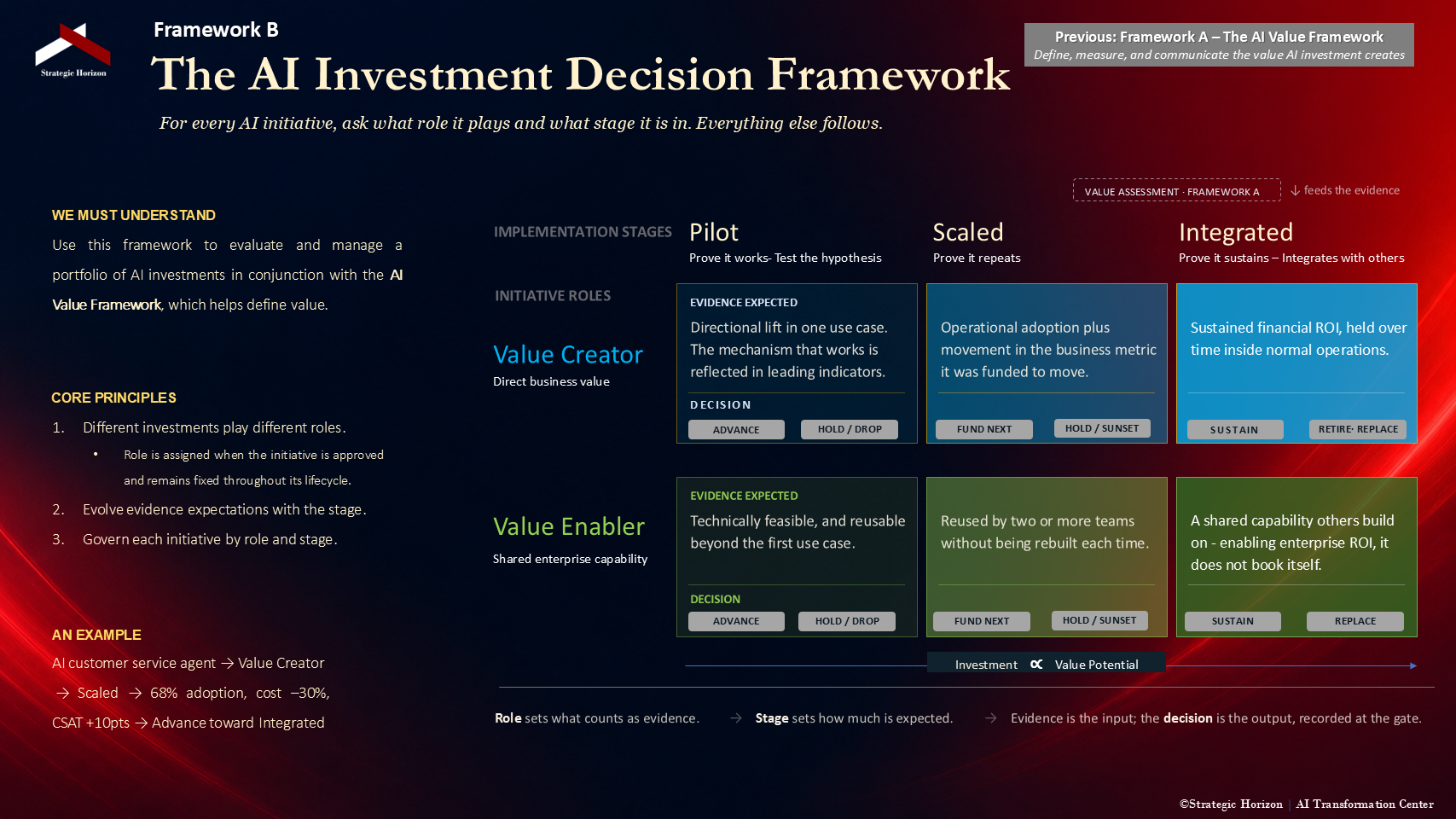
The AI Investment Decision Framework starts with two questions:
- What role does the initiative play?
- What stage is it in?
Every initiative is classified as either:
Direct Value
Creates measurable business value directly through its own business outcome.
Enabling Value
Creates or strengthens a shared capability that enables value across multiple initiatives.
Each then progresses through three stages:
And the evidence expected changes accordingly.
| Stage | Investment Question |
|---|---|
| Pilot | Does the hypothesis work? |
| Scaled | Does the value repeat? |
| Integrated | Does the value sustain? |
Evidence drives the decision
The framework deliberately separates evidence from decision.
At each stage, the organization defines what evidence should exist before the investment advances.
That evidence may be:
- Directional value indicators
- Adoption and operational performance
- Movement in defined business metrics
- Sustained financial ROI
- Reuse across teams or initiatives
- Enterprise-level value enabled by a shared capability
The decision then follows the evidence:
The result is a portfolio that is governed according to what an initiative is designed to accomplish and how far it has progressed, rather than forcing every AI investment through the same ROI test.
From isolated use cases to an investment system
The framework helps AI leaders and executives:
- Decide which AI initiatives deserve continued funding
- Set evidence expectations before money is committed
- Distinguish direct-value initiatives from enabling investments
- Avoid killing pilots before they have had a chance to prove their hypothesis
- Avoid indefinitely funding initiatives that fail to demonstrate expected value
- Establish explicit decision gates across the AI investment lifecycle
- Create a common language between business, technology, finance, and AI leadership
Explore the Value Studio
The AI Investment Decision Framework is the second half of Value Studio, a three-day working session that combines value definition with portfolio-level investment discipline.
18 one-hour sessions across three days, combining executive discussion, structured working sessions, and tangible outputs.
The question isn't whether every AI initiative has ROI today. The question is whether you know what evidence you should expect next — and what decision that evidence should trigger.