AI is widely described as a commodity; however, instead of taking popular opinion at face value, let's take a closer look at the model layer. Why? Because it impacts the AI Strategy enterprise CXOs formulate.
Fundamentally, a market becomes commoditized when buyers can treat suppliers as interchangeable and suppliers face enough competition to make that interchangeability sustainable. Both sides matter.
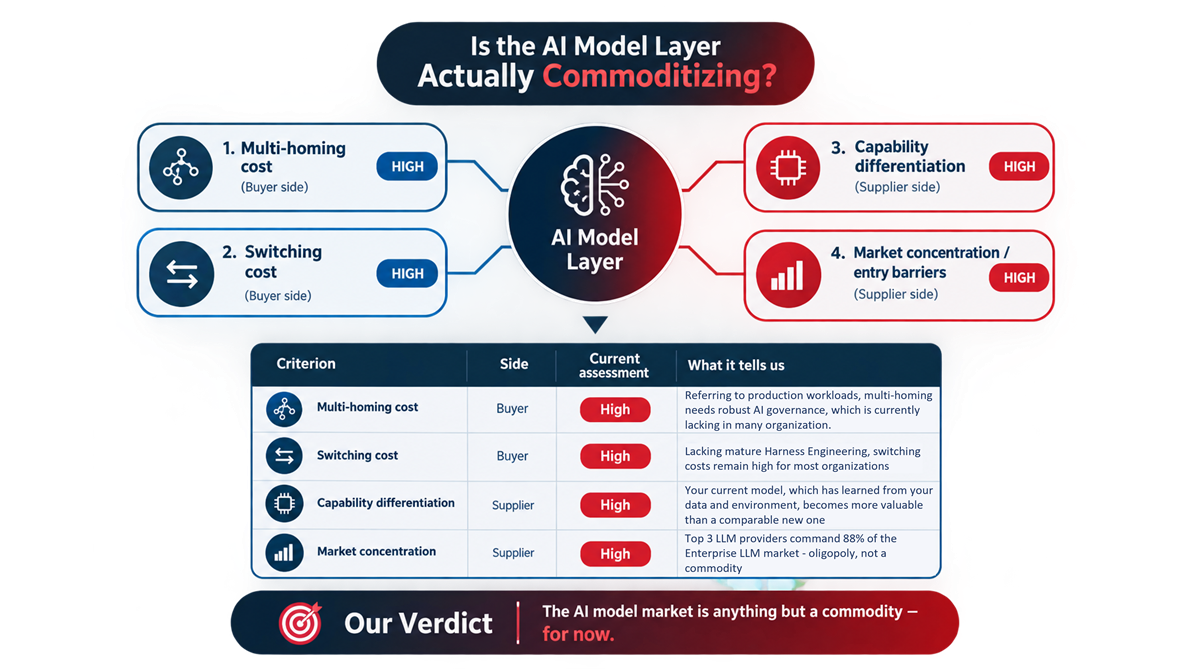
So, we use four tests to assess the AI model layer - the first two from the buyer side, and the next two from the supplier side: multi-homing cost, switching cost, capability differentiation, and market concentration/entry barriers. All of these criteria are inversely proportional to commoditization. A low score on any of these factors creates strong pressure toward commoditization, and a high score means it moves toward a monopolistic or oligopolistic scenario. So, let's check one factor at a time.
1. Multi-homing may seem easy until you create a harness around it
If I ask: how difficult is it to use more than one model provider? The answer will be: not very difficult. Model providers do not penalize customers for maintaining more than one model subscription, although the cost of having multiple model subscriptions with limits high enough to run production applications is not low.
Moreover, when you are scaling and take multiple models to production systems, running them will create real operating costs. You will need to build routing infrastructure, observability, evaluation pipelines, and engineering time. You'll also have to build static or dynamic routing to split volume across providers and optimize token consumption around their limits.
Once an enterprise has established these standard operating practices and built harness architecture, adding another model becomes much easier. But until that happens, the real cost of multi-homing will remain high. And that ensures enterprises stick with their model providers - something that is the opposite of commoditization.
2. Switching is still an enterprise problem
Like multi-homing, switching providers also appears simple at the outset. You can always switch the window from Claude Desktop to ChatGPT, and the API endpoint and key are also not that difficult to change during system-to-system calls. What is difficult to replicate is the surrounding system for the new model.
Once again, AI Harness weaknesses surface at the top. Prompts, evaluations, guardrails, workflows, and accumulated context can become closely tied to a model. For example, if you had relied on caching as a mechanism in building AI applications, switching from Claude to OpenAI would have been impossible before June 2026. The problem gets bigger when many people across the organization build around the same model and collaborate along the same operating practices, essentially creating a network effect.
The kind of Harness Architecture you build around AI matters here more than anything. An enterprise with a strong, yet adaptable AI harness can isolate applications from the underlying model and make switching easier. However, enterprises that embed model-specific context directly into applications will make it impossible to switch to a different model.
Given the current level of AI implementation, switching costs remain high for most organizations, and the commoditization pressure from this factor remains low.
3. Most AI capabilities are substitutable. Really?
The third test of commoditization is whether one model can replace another without materially changing the outcome.
Once again, what we see on the surface is not what we see in the nuances. Yes, it's true that - pick any frontier or sub-frontier model, and it will do an acceptable job on common workloads like text synthesis and coding. They start differentiating on use cases like image generation, video generation, sophisticated chain-of-reasoning analysis, and specific optimization features among a few.
Moreover, AI capabilities are highly dependent on your enterprise ecosystem and the data you fine-tune the model on. So, the model you have used in your organization is generally more capable than a comparable model that is new to your organization because the first one has learnt about your organization. It is similar to human employees - the one you have must have gone through organizational training and cultural orientation, and that makes them more capable than somebody else who is as skillful but new to your organization. Although they both - human and AI - will catch up, they are not equal at the present moment.
So, capability differentiation starts playing a role when AI has scaled to production, and therefore it also works against commoditization.
4. The market may look open, but numbers tell us it is still concentrated
According to Menlo Research's estimates, Anthropic leads with about 40% of enterprise LLM API usage, OpenAI takes the second position with ~27%, and Google follows with ~21%. Together, the top-3 account for ~88%. So, at the frontier, the model market is an oligopoly rather than a commodity (source: Menlo: The State of Generative AI in the Enterprise).
Now, of course, recent developments in open-weight models, especially ones originating from China, may give an impression of an open market. I am yet to find a CXO in North America who has put a DeepSeek, a Kimi, or a Z.ai into an important production application.
Although OpenRouter routing data shows that Chinese open-weight models are moving from a usage level of 5 trillion tokens per week in April 2025 to more than 20 trillion by April 2026, it is largely at the individual developer level for PoCs and pilots, not at the production level. So, while developers have moved toward cheaper and more interchangeable models, enterprises are still relying largely on the top 3 for production use cases.
And that once again points to more dominance, not commoditization.
So, if we summarize all these factors and our current assessment, it becomes clearer that the AI market is anything but commoditized.
| Criterion | Side | Current assessment |
|---|---|---|
| Multi-homing cost | Buyer | High |
| Switching cost | Buyer | High |
| Capability differentiation | Supply | High |
| Market concentration | Supply | High |
Our verdict
The model market is anything but a commodity market, at least for now. Currently it is an oligopoly, and the money flow clearly supports that.
If your AI strategy relies on a commoditized market with the expectation that there will be more competition and prices will continue to fall, you will be disappointed.
Our assessment and the verdict will change if AI harness standards mature and agents and most organizations make robust AI governance and Harness Engineering their priority, capabilities start plateauing among frontier models, regulators put restrictions on new capability development, or anti-competitive laws (like the EU passed on Google Gemini) restrict market share growth of current leaders of the market.
Download the full PoV for the complete four-test framework, the assessment table, and what would change our verdict.