AI has captured 86% of US venture dollars, concentrating capital in a handful of frontier companies while early-stage and non-AI startups struggle. Yet exits for investors remain weak because enterprise deployment lags model development. While AI makes it easy to launch an idea, at the same time, it erodes competitive moats. Together, these signals raise uncomfortable questions about whether the AI economy is nearing its peak. We believe – Yes, we are close.
In November 2022, AI set off the biggest disruption venture capital has seen since the internet. What followed was that, in most VC fundings, AI became a new category altogether, which has only grown in the last 4 years. However, in the last few months, AI stopped being a category and became a password. Say the word in your pitch, and you get a seat at the table. Leave it out, and you do not even get a meeting. It is the kind of frenzy that usually shows up near a market top, which makes the question “Is This the Peak of the AI Economy?” worth taking seriously.
The numbers, recently published in Q2-2026 Venture Monitor report (by PitchBook and NVCA), make it hard to argue otherwise. In the first half of 2026, 86 cents of every venture dollar went to an AI company. Compare it with the same number 10 years ago, and you see AI is eating almost the whole venture funding pie, and leaving crumbs to everything else. In 2016, AI product pitches were getting 15 cents. Non-AI startups, the delivery apps and fintechs that once filled pitch decks, are now fighting over what is left.
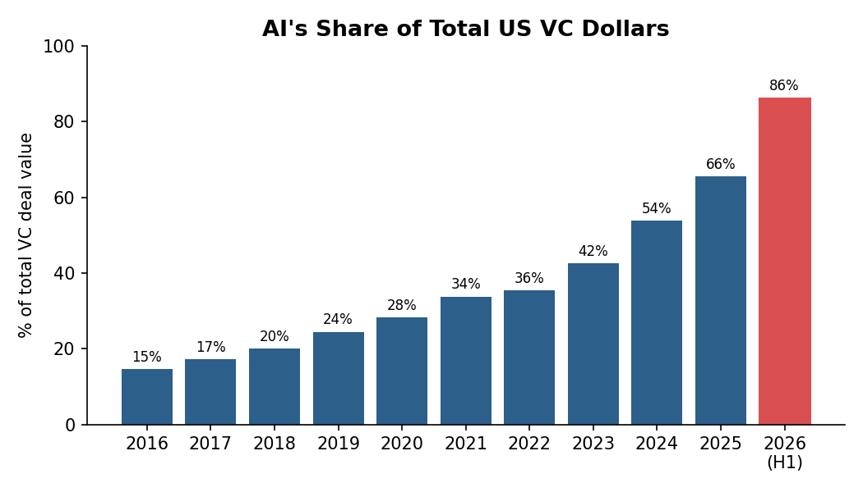
So, one thing is clear: the venture money is not spreading out. It is stacking at the top. In January 2026, Anthropic raised its funding at an enterprise valuation of $350 billion. Huge, by past standards. But then, three months later, in April 2026, it raised capital again, but this time at $965 billion. What happened in between? It had launched Claude Code. And all the money that was in SaaS and IT Services companies appeared to have flown overnight to Anthropic’s SaaS-killer, Claude Code.
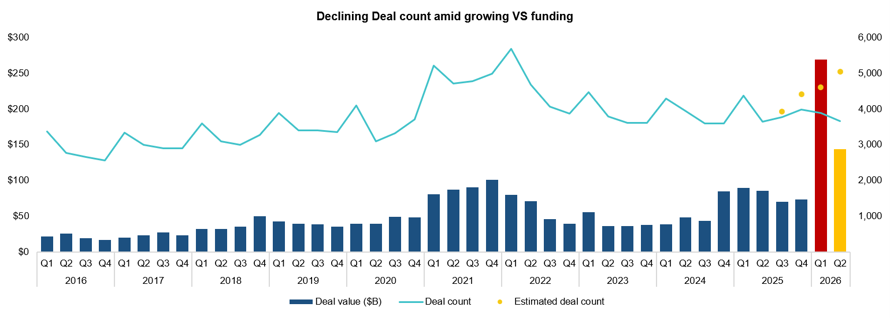
Separately, in the last quarter, we saw seven $1B+ VC funding rounds, and five of them went to AI companies. What is more worrisome to small non-AI startups is that deals under $100 million, which once used to be the bread and butter of early-stage investing, now reduced to 12% of total value this year. It came down from 44% two years ago. So, essentially, the middle of the market has disappeared.
The exit door is barely open
Now, of course, VCs are not forever investors. They need to rotate and return money to their Limited Partners regularly. And IPOs are a way to make this "exit" happen. This year's exit numbers look like a blockbuster year, but that's almost entirely because of one company: SpaceX (its stock market debut alone was worth more than the last 10 years of exits combined). Take SpaceX out of the picture, and it's actually still a pretty slow, disappointing year for everyone else waiting to cash out. And notably, SpaceX is not an AI company. The AI tags absorbing 86 cents of every venture dollar have yet to return their first one.
One thing that nobody wants to say out loud
Of course, AI made it cheaper to build a new product, to start a new business. At the same time, it also made it cheap to copy anything. As a result, the moat that used to take years and real capital to dig can now be crossed by any team with the right model and a free weekend. An idea does not stay yours for long when the same technology that helped you build it can help someone else rebuild it faster and cheaper. For investors, that is the uncomfortable math: the same technology commanding record valuations is also dissolving the moats those valuations are supposed to price in. So, VC exits will become trickier as the AI pie grows.
The growing deployment gap will hamper AI value realization
While the frontier model development is touching new avenues every other week, there is a structural disconnect between an organization's ability to try out those models to build impressive AI prototypes and its ability to scale those use cases to production. So, while almost every organization globally has experimented with AI at some level, only one in ten has successfully been able to deploy agentic workflows and realize financial value.
This structural disconnect is what industry calls the deployment gap. The reason behind this gap is the need for compliance, adequate security, tackling legacy debt, and unmapped processes. Essentially, everything that turns a set of capabilities into an organization.
It has been there with all previous technologies, where enterprise deployment of new technology progresses linearly. However, the AI frontier models’ exponential pace has widened this gap to an unforeseen level.
Unfortunately, players who could help mitigate this gap and help realize AI’s value for enterprises faster have neither been ready nor found many investors. SaaS and IT Services companies are at their all-time low.
It is still a Bay Area story, and that makes it a geographical risk
Now, all AI development we see is centralized geographically; it is happening mostly in one place. And this did not happen by accident as money, talent, and revenue keep finding their way back to this small stretch of Northern California, the Bay Area. The people who can build frontier AI are rare and mostly live there. While the tools to build are getting cheaper everywhere, the value they create keeps landing in the same zip codes. This is the Silicon Valley story again, just a lot bigger than it has ever been. And for the peak question, that concentration cuts both ways: it compounds the gains on the way up, and it concentrates the damage if things turn.
So, is this the peak of the AI economy, and is the bubble about to burst? Well, bubbles rarely send a warning before they pop. Even as many of us realize all these gaps, the folks with money will keep pouring drinks until the band stops playing. However, what we know today is that the map has shrunk, the barriers to entry have dropped, the deployment gap keeps widening, and staying ahead has never cost more.