When Nvidia announced that Jensen Huang had resigned as CEO for widely known reasons, I told a tech media outlet that he would be back sooner or later. With Huang’s exit, Nvidia had lost a person who was its link with investors and governments.
On the same day, in a LinkedIn post, I had also argued that Nvidia’s moat was bigger than Jensen. I had said demand for AI compute would not vanish with one executive, and that Nvidia had institutionalized his vision. While most of it is still true, I refine my views later in this note.
Yesterday, on Nov 23, 11 days later, the board reinstated him. Interestingly, just six days earlier, the board chair had stated that the board did not intend to reinstate him as CEO. Then, in response to another LinkedIn post, I had commented, “The question is how long the board can resist,” restating my prediction that Huang would return.
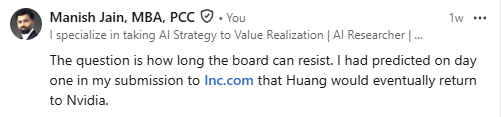
Now, it’s not that I am being a Matrix Oracle. It’s just that by this time it had become quite clear to me that the board could not hold out for long. This is a repeat of Sam Altman’s story: ousted, then brought back within days. Of course, that was a private company, and its board gave only a vague reason for the firing.
So, you might be asking, if the institution was strong enough to run without him, why could the board not hold its position for even a week? I would explain it by pointing to Nvidia’s two moats, only one of which is institutional.
Nvidia’s two moats
The first moat is technical. It covers the GPUs, CUDA libraries, and twenty-five years of engineering. That moat stayed as it was. Its customer clusters kept running, and the order backlog stayed in place.
However, the second moat was made of investors’ confidence and relationships with the government. It rested on capital markets, ecosystem financing and political connections. This one turned out to be personal and resulted in an approximate $1 trillion erosion in market value in 8 days (NVDA share price: Nov 11 $173; Nov 20 $125). The price came back close to where it was by the end of the day he was reinstated (Nov 23 $165). Essentially, there is no single individual in history who can claim to command $1 trillion of market cap, proved by price change.
So, when some industry leaders called for Huang’s return and POTUS exercised his influence, the board came under enormous pressure.
Also, Nvidia’s CFO, now interim CEO, failed to inspire confidence in the market. Nvidia has been financing many AI companies that buy its chips. So, when its interim CEO signaled a review of those commitments, it was a major red flag for America’s AI story, which is built on circular financing.
The board’s dilemma and key personnel risk
Also, I don’t envy Nvidia’s directors; nobody would. They had to weigh their fiduciary duty to shareholders, who reacted negatively to Huang’s exit, against the ethics and governance standards they needed to enforce. I also appreciate that letting a founder go is much harder than replacing a professional CEO. It is a textbook case of key personnel risk. A founder carries the company’s identity and investors’ trust, and both are priced into its share price.
With these dilemmas, the reinstatement can’t be clean.
In its announcement, the board said that it received input from senior levels of the United States government and was confident that Huang’s return poses no national security risk. Yet its independent committee and House committees are still investigating the issue. So, reinstating him before the investigation ends makes that investigation look futile.
For enterprise buyers, the point to note is where Nvidia’s big decisions are now made: with the founder, the board or from outside the company.
Did the board make the right decision in reinstating him?
In the short term, the board has certainly stopped the bleeding in Nvidia’s stock price. However, it has also created a precedent that corporate governance comes second to pressures from financial markets and government.
Does this create risks to Nvidia’s customers?
Since the reinstatement was announced, several people have asked me whether this opens businesses to cybersecurity trouble. Put simply, I see no direct link today. Nothing in the public record suggests that Nvidia products, firmware or customer data were compromised.
However, CIOs should still treat Nvidia as a supply-chain risk, regardless of whether they can mitigate it or have no choice but to accept it.
A supplier at the center of an espionage case remains a target for phishing and impersonation, so expect attackers to use Nvidia leadership and export compliance as lures in the coming weeks. Nvidia’s drivers, CUDA libraries and enterprise AI software also run with high privilege in many data centers. If the investigation reveals any exposure of roadmaps or code, software provenance and patch cadence become urgent.
Finally, Nvidia has created a board committee for national security and export controls, which signals tighter rules on who can buy which chips and where. A compliance shock can strand capacity faster than any breach.
The challenge for CIOs is to figure out what they can do about supplier exposure of this kind, and what happens if they do nothing. A third question follows: does knowing where you have leverage help you make better decisions? Let’s take them one by one.
Can you, as a CIO, do anything about it?
With Nvidia, I’d say, very little. Most CIOs are simply takers here. You can’t change Nvidia’s board, its founder’s grip on the ecosystem or Washington’s role in its decisions. The pattern also reaches well beyond Nvidia. Whether it’s OpenAI, Musk’s companies, Meta or most other frontier AI labs, they all carry founder weight that rivals their products. As an enterprise CIO, you have built core processes on these suppliers, so their founder risk has quietly become your enterprise’s risk.
What happens if CIOs do nothing?
Most of the time, nothing visible happens. The cost stays hidden until a shock, and then it arrives all at once. I can foresee scenarios like these:
- A prepaid GPU reservation lands on a chip generation or region that an export rule makes unusable.
- A cloud service provider (CSP) reprices capacity after a supply shock, and the contract offers no room to push back.
- A supplier pulls back ecosystem financing, a neocloud fails, and the enterprise’s capacity turns out to be sitting on that neocloud.
- A founder exit at a model provider changes its roadmap, its API terms or its deprecation schedule, and agents built on prompts tuned for one model stop working well.
These may sound far-fetched until they actually happen. So, CIOs must track them in the risk register.
Where do CIOs have leverage, and where do they not?
While you may not have leverage over Nvidia, there are still things within your full or partial control or influence. So, the first step is to sort the exposure honestly into three groups.
- No leverage: supplier boards, founder conduct, export controls, government policy, chip allocation, frontier model roadmaps.
- Indirect influence: infrastructure and cloud contract terms, disclosure demands through CIO councils and industry groups.
- Direct control: data, prompts, evaluation sets and orchestration, length and size of capacity commitments, risk register, and board reporting.
The first group is like weather, so CIOs should track it and plan for it, instead of spending effort trying to change it. The second group works through others: hyperscalers have leverage over Nvidia that a single enterprise lacks, and buyers acting together can shift what suppliers disclose, much as customers once did with security questionnaires. The third group is in the CIO’s control.
For the second and third groups, managing risk costs money, so CIOs should spend only where the workload is critical and a substitute exists. Where no substitute exists, accept the risk and record that decision with the board. CIOs should also treat founder dependence and close government ties as supplier risks.
Where I land
I still hold that Nvidia’s moat lies in its engineering and products, and that it can survive a change at the top. I would add that the trust built around a founder is harder to hand over. While Nvidia made the first strength institutional, it has not fully done so with the second. And, companies that depend on Nvidia, of varying degree, are exposed to that distinction too.
What next for Nvidia?
I doubt the last word has been said on this. The investigations are unfinished, so I wouldn’t be surprised by more moves at the top in the coming weeks.