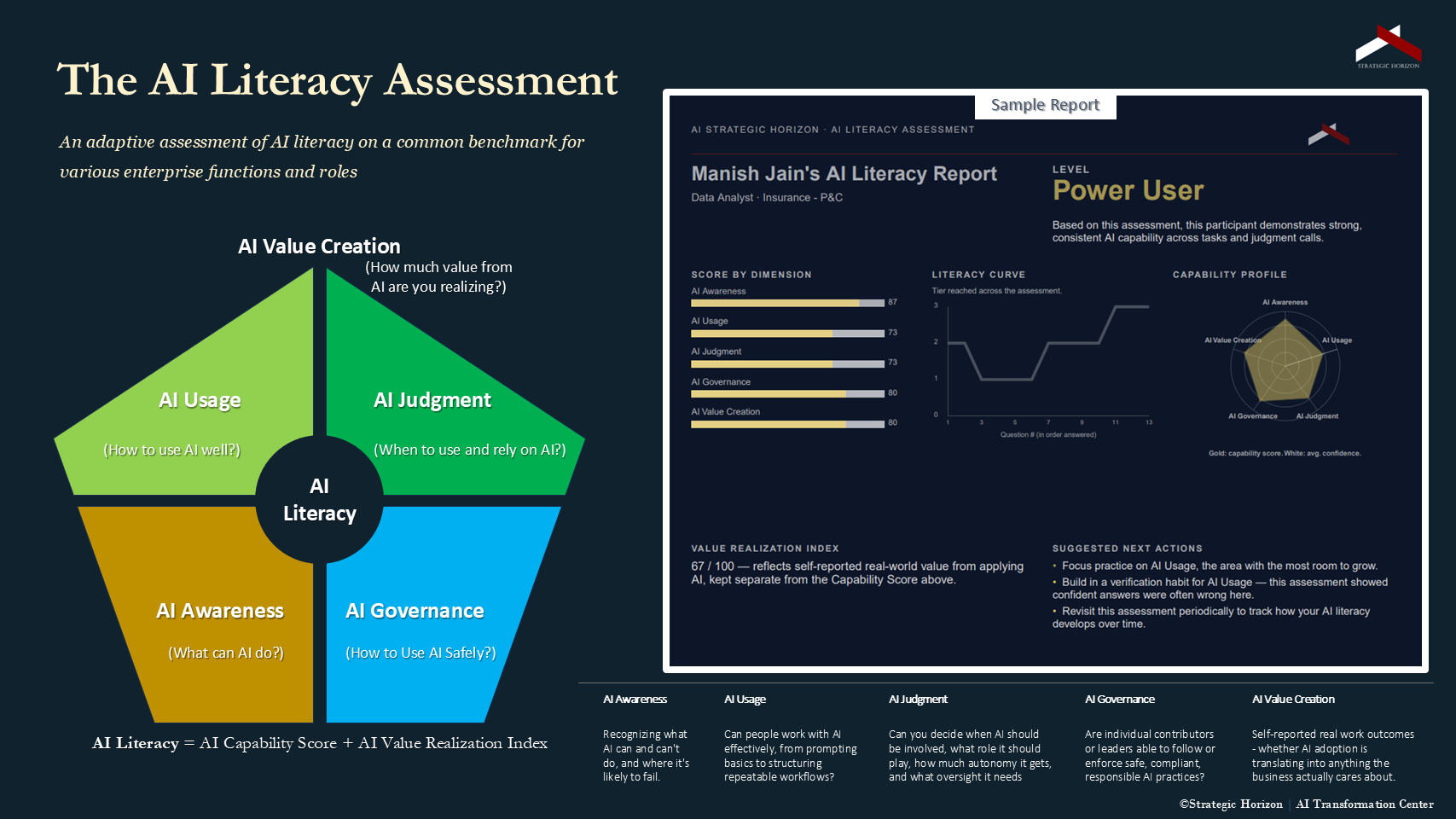
Assessing AI literacy of the enterprise workforce is a common challenge to drive AI adoption, AI transformation, and ultimately value realization.
However, when it comes to AI literacy assessments, many think it is about whether someone understands AI as a technology. We differ, respectfully. Our framework measures whether people can use AI to create business value while making sound decisions, managing risk, and following organizational policies.
The framework is built around four core capability dimensions that together produce a single AI Capability Score.
• AI Awareness measures a person's understanding of what AI can and cannot do, including its limitations and failure modes.
• AI Usage evaluates how effectively they apply AI in everyday work through prompting, tool selection, and repeatable workflows.
• AI Judgment assesses the ability to decide when AI should be used, how much autonomy it should have, and what level of human oversight is required.
• AI Governance measures safe, responsible, and compliant AI use, with assessments tailored for individual contributors and leaders.
Alongside these capabilities, the framework measures AI Value Creation separately through a Value Realization Index. Rather than assessing how often people use AI, it evaluates whether AI is producing meaningful improvements in work outcomes such as productivity, quality, decision-making, innovation, or customer experience.
Recognizing that AI literacy is context-dependent, the framework does not evaluate everyone against a single universal standard. As the benchmark dataset grows, individuals are compared with peers in similar roles, functions, industries, and organizational contexts, providing a more meaningful view of capability and value realization. This enables organizations to identify strengths, uncover skill gaps, prioritize targeted development, and track AI literacy and business impact over time.